
How Integrated Care at Hands of Hope Can Help Your Pickleball Injuries
Did you know that pickleball is the fastest-growing sport in America, and the game is gaining more and more players every day? At Hands of Hope, we completely understand why: pickleball is an easy and fun way to stay active. The sport is similar to other racquet sports, but is often easier for beginners to pick up.
No matter your skill level or experience with pickleball, learning how to properly prepare your body is key to enjoying the sport. Unfortunately, people jump right into the sport without any preparation or training to prepare their bodies for the demands on their muscles, tendons, and joints. This can quickly lead to injuries, even if pickleball might be more accessible than other racket sports.
There’s good news, though: our team of physical therapists and pain management specialists has proven success in helping people of all ages recover from injury and resume the sport they enjoy.

The Most Common Injuries Associated with Pickleball
Pickleball’s popularity has opened it up to people of all ages. The game is easy to play for beginners and can also meet the needs of a more competitive player, with the potential for fast-paced singles or doubles matches. But as the popularity grows, so too does the risk of injury.
The sport requires abrupt changes of direction, as well as stopping and starting movements, all of which have been linked to non-contact injuries such as sprains and strains. There is also potential for falls and repetitive-motion-type injuries, especially to the upper extremities. Another potential risk of injury stems from inadequate preparation and the age of the deconditioned athletes.
The most common pickleball injuries we see at Hands of Hope include:
- Wrist fractures from falls
- Ankle sprains
- Achilles tendon injuries and inflammation
- Knee cap tendinopathies
- Hamstring, inner thigh, or quadriceps muscle strains
- Shoulder impingements and other rotator cuff injuries
- Tennis elbow
How Our Team Can Help You Excel on the Pickleball Court
We approach pickleball injury recovery through a coordinated model that blends physical therapy, medical pain management, and supportive wellness services to help you move forward with confidence.
Your program begins with a detailed evaluation to identify movement limitations, strength deficits, and contributing factors, allowing the team to build a plan that is both individualized and goal-oriented. While no two plans are alike, here are just some of the services that we might recommend:
Advanced Rehabilitation Modalities
We offer several state-of-the-art treatment techniques to help boost your body’s natural healing process, including:
- Shockwave therapy to support tissue healing and recovery
- EMG biofeedback to improve muscle activation and control
- Neufit neuromuscular stimulation to accelerate strength gains and neuromuscular efficiency
- Kinesio taping to address soft tissue limitations and provide functional support
Integrated Pain Management
We also offer the strategic use of pain management techniques to allow continued participation in therapy even when pain levels are high. Depending on your needs, we might recommend:
- Joint injections to address inflammation of the soft tissues in the knees, hips, or elbows
- Trigger point injections to address myofascial restrictions in the body that can cause local or referred pain, often as a result of repetitive use injuries
Hands-On Physical Therapy
Movement-based therapy plays an important role in addressing movement or strength inefficiencies that can increase your injury risk. Physical therapy techniques include:
- Manual therapy to improve joint mobility and reduce soft tissue restrictions
- Targeted therapeutic exercise programs to restore strength, coordination, and stability
- Neuromuscular re-education to enhance movement patterns and reduce reinjury risk
- Strength and conditioning strategies designed to improve power, endurance, and movement efficiency
- Gradual return-to-activity programming with emphasis on long-term resilience
Wellness and Recovery Services
We also offer ongoing wellness support to maintain progress beyond formal therapy, including:
- Yoga and guided exercise programs to support flexibility, balance, and mobility
- Compression therapy and recovery modalities to reduce soreness and promote circulation
Request an Appointment Today!
At Hands of Hope, our team has extensive experience treating pickleball-related injuries, and we’ve worked with athletes of all skill levels and ages.
Don’t let an injury keep you from spending time on the pickleball court. Call today to schedule an appointment with one of our specialists!
Sources: https://www.ncbi.nlm.nih.gov/pmc/articles/PMC6913863/, https://journals.lww.com/acsm-csmr/Fulltext/2020/10000/Pickleball__Review_and_Clinical_Recommendations.8.aspx?context=LatestArticles, https://www.sciencedirect.com/science/article/abs/pii/S0736467919307991
Exercise of the Month
Median Nerve Glide
(Arms, Nerve Mobility)
Stand tall with your arm extended in front of you at shoulder height, palm facing up. Use your opposite hand to gently grasp your thumb. Slowly extend your wrist and fingers back. Return to the starting position with control. Perform the motion gently and smoothly.
3 Sets, 10 Reps (each arm). (Materials needed: none)
Live Comfortably Once Again with Occupational Therapy
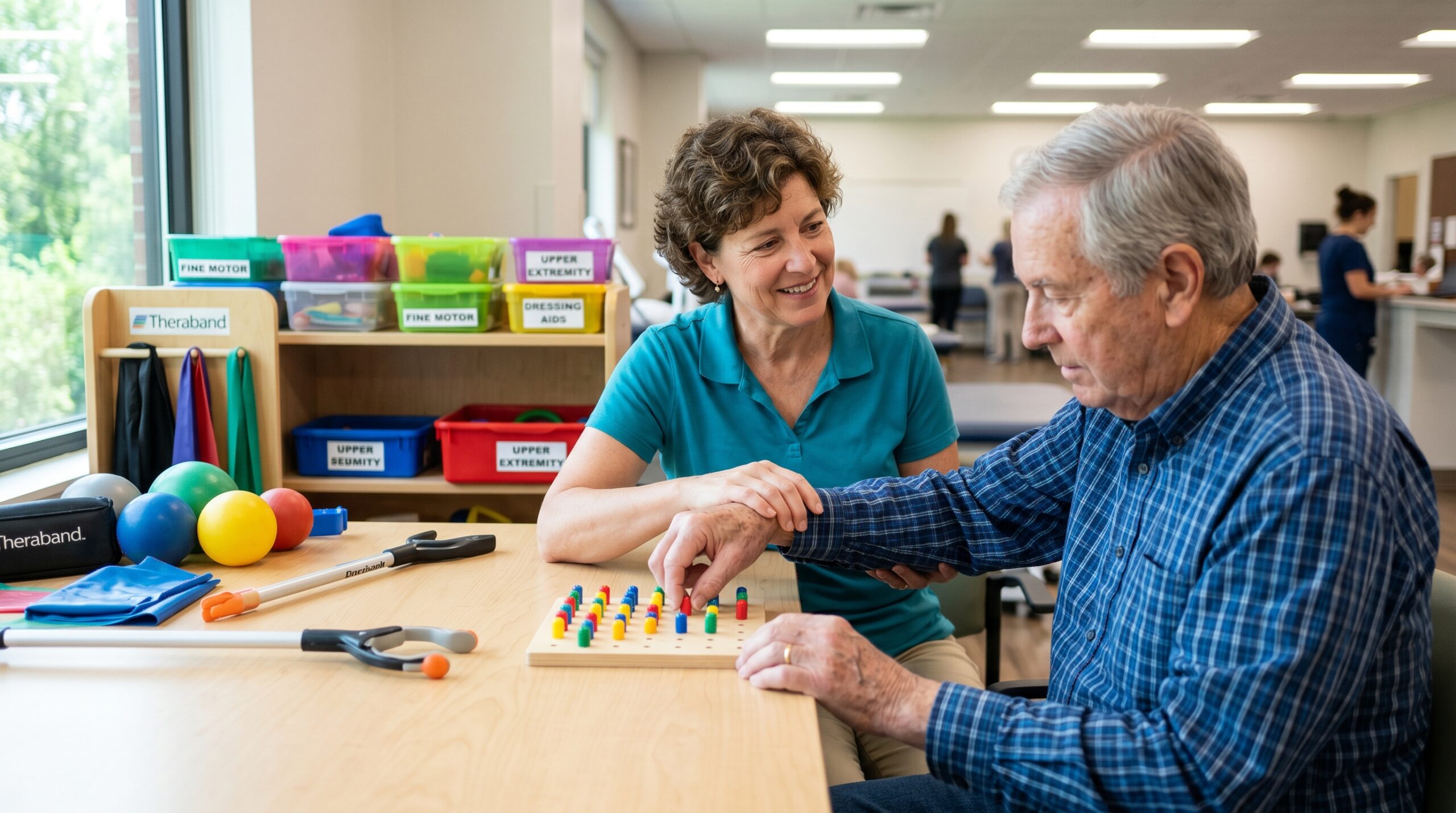
Are you recovering from a recent injury or surgical procedure? Are you living with a chronic condition that causes constant discomfort? Whatever the case may be, occupational therapy can help improve your health. At Hands of Hope, our occupational therapists can help you restore your function and teach you the skills to manage your daily activities.
Occupational therapy helps people from young to old do the things they want and need to do. This kind of therapy works with people of all ages to live their lives to the fullest by promoting health and/or helping with an injury, illness, or disability.
Occupational therapists (OTs) treat injured, ill, or disabled patients with the therapeutic use of everyday activities by implementing strategies to help patients recover, improve, learn and maintain the skills needed for daily living and working duties.
If you are experiencing discomfort, contact Hands of Hope today for more information.
What conditions are treated by an occupational therapist?
The word “occupation” is used to describe activities of daily living, instrumental activities of daily living, health management, rest and sleep, education, work, play, leisure, and social participation.
Occupational therapists work with people to address their physical, cognitive, psychosocial, and sensory-perceptual limitations. OT aims to help improve a person’s performance and engagement in occupations that affect physical and mental health and quality of life.
OTs work with elderly patients to teach them techniques to make completing daily tasks, such as dressing, eating, and bathing, much more manageable. In addition, we also help patients improve their fine and basic motor skills, strength, dexterity, and range of motion.
Occupational therapy focuses more closely on hand, elbow, and wrist pain relief. Some common conditions we treat with OT, through our specialized hand therapy services, include:
- Carpal tunnel syndrome
- Arthritis
- Burns
- Nerve injuries
- Fractures
- Tendinitis
The medical conditions that occupational therapists often treat include the following:
- ADHD
- Chronic pain
- Stroke
- Diabetes
- Spinal cord injuries
- Brain injuries
- Multiple sclerosis
Everyday personalized activities that people do as individuals, in families, with communities and to occupy time bring meaning and purpose to life. Occupations can involve the execution of multiple activities for completion and can result in various outcomes.
Whether you’re dealing with an old or new issue, conservative care of an occupational therapist is one of the most effective ways to treat pain and injury. The goal of rehabilitation is to help you regardless of your current condition or the setting you need assistance in. We will help you participate in the activities you need and want to do.
What to expect at an occupational therapy visit
Occupational therapy is more than just addressing an injury. At Hands of Hope, our dedicated therapists focus on the functional needs of each patient by implementing specific exercises and activities that promote physical and psychological well-being.
We will perform a thorough evaluation, determine the best course of action, and implement the strategies to ensure a positive outcome. We may also include evaluating your home and other environments (i.e., workplace, school) and making recommendations for adaptive equipment and/or training to fit your needs.
Our team will implement compensatory techniques to help you perform tasks in an alternative manner or by using adaptive aids to be more independent. We can also use compensatory strategies to help you learn new tasks when your abilities and current situation dictate a new way.
Occupational therapists use a holistic perspective, focusing on adapting the environment to fit the person. You will feel better emotionally when you can comfortably engage in essential activities. This unique approach makes occupational therapy a vital part of your health care.
Call to schedule an appointment
Whether you are looking for relief, looking to prevent an injury, or simply improving your physical function, occupational therapy is here for you. Our skilled OTs will work closely with you to help you reach your goals!
If you’re ready to get started on the path toward improved health, contact our office today!
Sources: https://go.gale.com/ps/i.doid=GALE%7CA623794176&sid=googleScholar&v=2.1&it=r&linkaccess=abs&issn=02729490&p=HRCA&sw=w&userGroupName=ar_a_otcl, https://www.aota.org/conference-events/otmonth/what-is-ot.aspx

Swamp Soup
This swamp soup, named for its vibrant green color, is made from a combination of spinach and parsley blended into a silky base, with fiber-rich white beans, shredded chicken and brown rice stirred in for a satisfying texture. A sprinkle of fried garlic and crushed red pepper adds savory crunch and gentle heat to each spoonful.
Ingredients:
- 2 tablespoons extra-virgin olive oil, divided
- 1 medium white onion, chopped
- 1 (1-inch) piece fresh ginger, peeled and chopped
- 3 medium cloves garlic, minced
- 4 cups unsalted chicken broth
- 4 cups baby spinach
- ½ cup coarsely chopped fresh flat-leaf parsley, plus more for garnish
- 1 tablespoon lemon juice
- ½ teaspoon crushed red pepper, plus more for garnish
- ½ teaspoon salt
- ¼ teaspoon ground pepper
- 1 (15-ounce) can no-salt-added white beans, rinsed
- 1 cup shredded cooked chicken breast
- 1 cup cooked long-grain brown rice
- 1 tablespoon fried garlic (such as Maesri) or fried onions
Instructions:
- Heat 1 tablespoon oil in a large saucepan over medium heat. Add chopped onion, chopped ginger and minced garlic. Cook, stirring constantly, until the onion is softened, about 5 minutes.
- Add 4 cups broth and bring to a simmer over medium heat. Stir in 4 cups spinach, ½ cup parsley, 1 tablespoon lemon juice, ½ teaspoon crushed red pepper, ½ teaspoon salt and ¼ teaspoon pepper. Cook, stirring occasionally, until the greens are wilted and tender, about 5 minutes.
- Puree the soup in the saucepan using an immersion blender until smooth, about 2 minutes. (Alternatively, working in batches, pour the spinach mixture into a blender. Secure the lid and remove the center piece to allow steam to escape. Cover with a clean towel and process until smooth, about 1 minute. Use caution when blending hot liquids.)
- Stir in rinsed beans, 1 cup shredded chicken and 1 cup cooked brown rice. Cook over medium heat, stirring occasionally, until the soup is heated through and slightly thickened, about 5 minutes.
- Divide the soup among 4 bowls. Drizzle with the remaining 1 tablespoon oil and top with 1 tablespoon fried garlic. Garnish with additional parsley and crushed red pepper, if desired.
We’re Here to Help, Every Step of the Way
We know pain can be alarming, but you don’t have to manage it alone. A personalized therapy program from Hands of Hope can help reduce your symptoms so you feel more confident in your day-to-day life.